Sparks of Joy and Bizarre Barges.
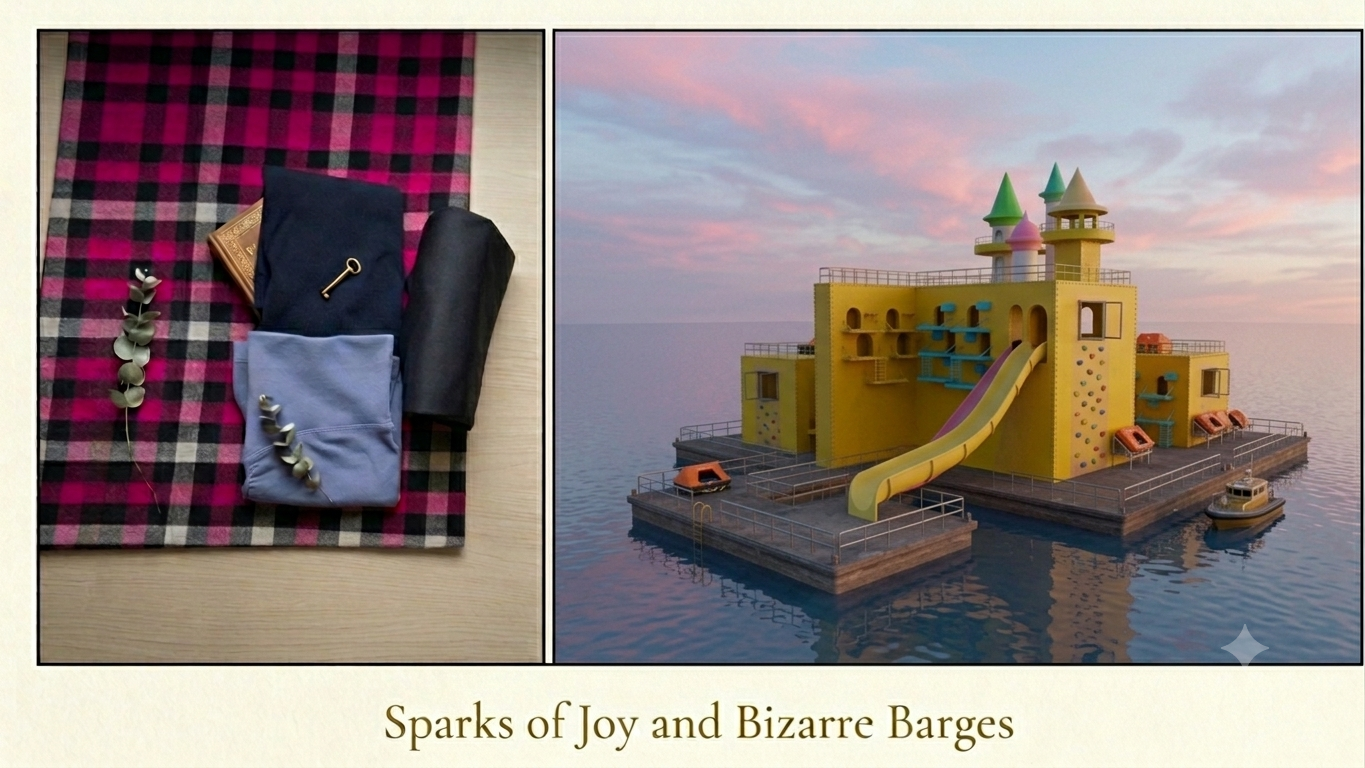
Reality television has earned a reputation for thriving on chaos, drama, and the louder, messier sides of human conflict. Yet, tucked away from the noise are rare gems that trade in an entirely different currency, gratitude. Netflix’s Tidying Up with Marie Kondo and the Korean reality series Kian’s Bizarre B&B could not look more different. One takes place in quiet, cluttered suburban homes, and the other unfolds on a whimsical, doorless barge floating in the middle of the ocean where guests must slide out of the house to exit. But when you look past the sheer entertainment value, you realize they share an exact heartbeat. Both shows prove that joy is not a passive accident. It is an intentional choice, and to experience it, we must actively create the space for it whether by clearing out our external environments or stepping entirely outside of our comfort zones.
The starting point for both shows lies in a simple truth, that our physical environment is a direct reflection of our mental state. In Tidying Up, the emotional fog of a household is made visible through mountain-sized piles of clothes and forgotten boxes. As Marie Kondo guides families through her method, a deep realization emerges. The clutter isn’t just “stuff”, it is a physical manifestation of fear, stagnation, and the inability to let go. It clouds family bonds, making people feel overwhelmed and disconnected, convincing them that they don’t love or appreciate each other when, in reality, they are just suffocating under the weight of daily routines.
Kian’s Bizarre B&B addresses the exact same mental weight, but it targets the clutter of the mind rather than the closet. The guests who arrive at the floating barge are carrying the invisible baggage of daily worries, burnout, and societal chaos. They arrive seeking to breathe, to escape if only for a couple of days. Whether it is a home buried under old shoes or a mind buried under everyday stress, both shows begin in the same place: with people who need to declutter their lives to find room to breathe.
While the problem is the same, the two shows design completely different escape routes to shake their participants awake. Marie Kondo acts as a quiet, gentle guide. She famously does not clean for you, she provides the five-step framework and steps back, forcing you to go through the difficult mental process yourself. The joy discovered in her show is self-actualized. It comes from an internal reckoning, proving that sometimes, the barriers we face are entirely in our heads.
Kian takes the opposite approach, using the sheer force of a bizarre, external imagination to shock people out of their rigid mind-sets. To even enter the B&B, guests must leave the mainland on a boat, climb to a second floor, and navigate a house without traditional doors. By forcing people into a space that subverts every logical expectation of daily architecture, the show instantly breaks the monotony of their lives. Marie coaxes the joy out by turning her subjects inward while Kian pulls the joy out by thrusting his guests outward into a world of pure wonder.
At the core of all this, is a brilliant contrast in how we interact with the things that give life meaning. Marie Kondo teaches about the joy of letting go. She introduces a radical perspective on gratitude, once an object has finished serving its purpose, you don’t just shove it into a corner or hold onto it out of fear that you might need it someday. You thank it, appreciate it, and let it go serve its purpose somewhere else. She challenges us to picture our spaces clearly , why surround something that sparks genuine joy with five other things that don’t? Releasing the old is what allows the happiness within us to finally surface.
Conversely, Kian’s Bizarre B&B teaches the philosophy of holding on, not to physical items, but to fleeting, irreplaceable human experiences. The stay on the barge is temporary, the goodbyes are heavy and sad because everyone knows this is a once-in-a-lifetime encounter. Yet, the show reveals that even a single, beautiful two-day experience can create a pool of joy that lasts a lifetime. Strangers are brought together in an unbelievable setting, and the shared vulnerability creates a permanent anchor of gratitude. We clear the physical items to make space, but we hold onto the transcendent memories to keep ourselves full.
Ultimately, both Tidying Up and Kian’s Bizarre B&B lead their audiences and participants to the exact same destination. My emotions were all over the place watching them because both journeys are paved with a mixture of laughter and tears. The tears in Marie’s world are those of relief, the emotional weight lifting as a family finally sees each other clearly across a clean table. The tears in Kian’s world are those of a beautiful farewell, the bittersweet realization that a magical interlude has ended, but its charm exceeded every expectation.
Whether we are devoting more time and passion to the things that spark joy in our living rooms or cherishing a brief escape on a floating barge away from the chaos, the message remains singular. Joy requires an architecture. We must build it, clear the path for it, and defend it. When we finally do, we realize that the capacity for happiness and love was never really gone; we just needed to clear the view.